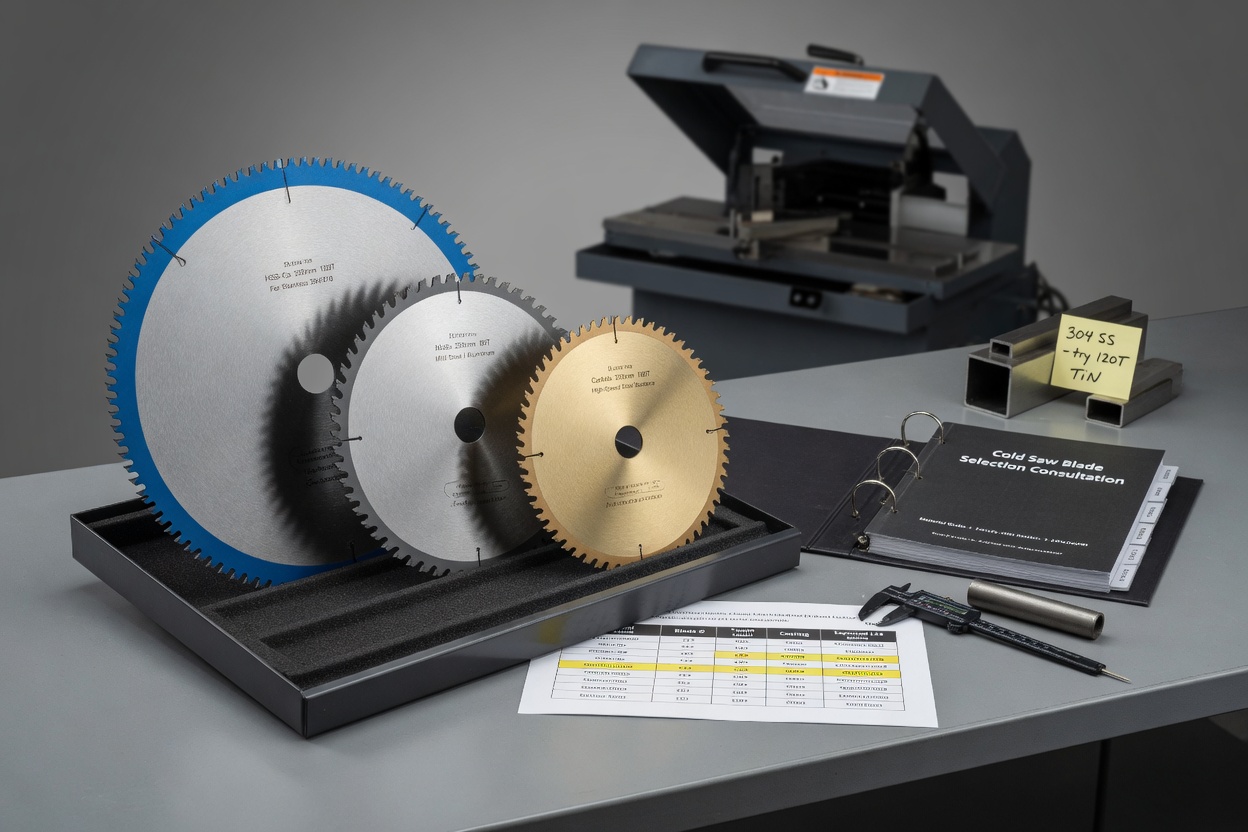
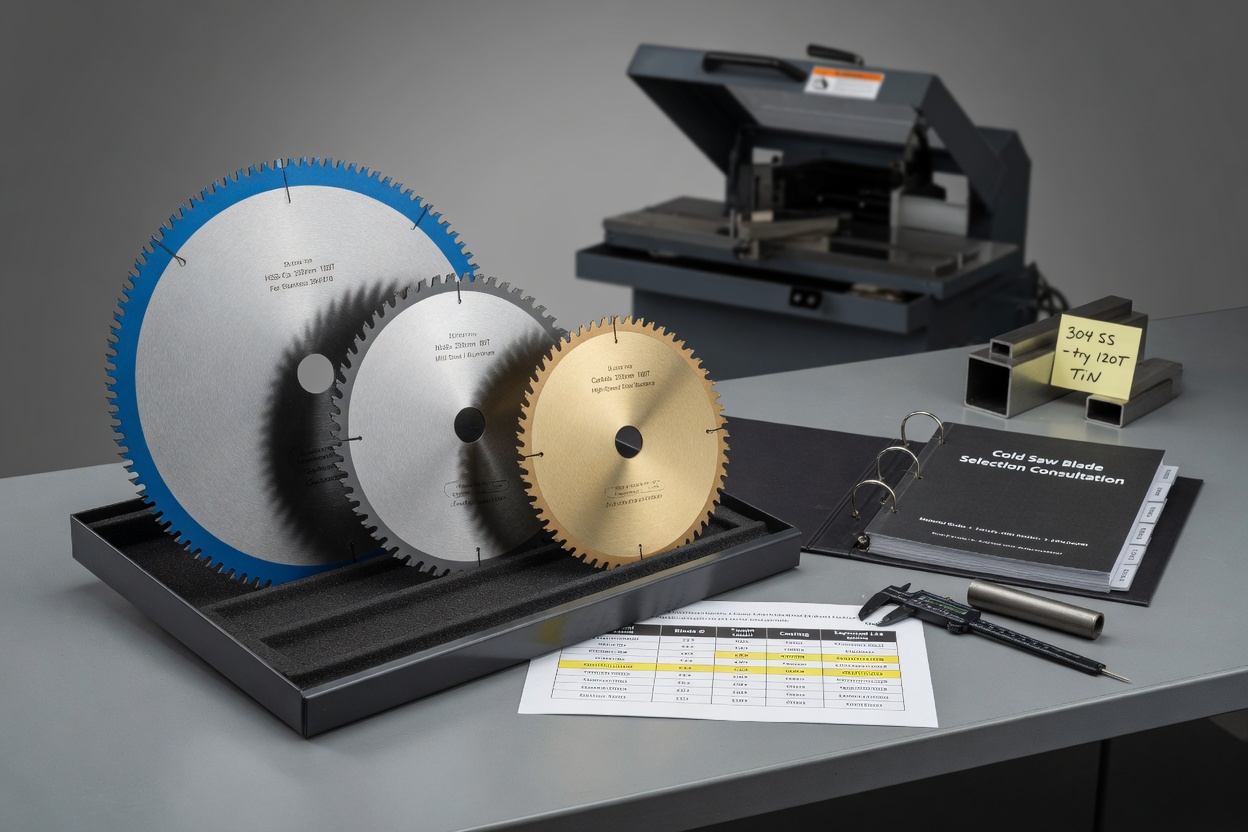
Cold Saw Blade Selection Consultation
Consultation to Choose the Best Cold Saw Blade
In precision metal fabrication, your cold saw is only as good as the blade mounted to its arbor. Choose correctly, and you get mirror-like finishes, square cuts, and a blade that lasts for thousands of cycles. Choose incorrectly, and you risk stripped teeth, work-hardened material, or a ruined workpiece.
Choosing the perfect cold saw blade is a precise science, not a guessing game. By breaking the selection process down into four critical phases, you can guarantee a perfect cut every single time.
Phase 1: Establish Your Machine’s Physical Limits
Before looking at teeth or coatings, you must look at your machine’s data plate. A blade must mechanically match your saw’s hardware. You cannot compromise on these physical parameters:
- Outer Diameter (OD): Your saw is engineered for a specific blade diameter (e.g., 250mm, 315mm, 350mm). Running a blade that is too small reduces your maximum cutting capacity and alters your surface speed. Running a blade that is too large will physically not fit inside the safety guard.
- Arbor Hole (Bore Size): This is the center hole that slides onto the machine spindle. Common sizes include 32mm and 40mm. The fit must be exact to prevent blade runout or vibration.
- Pin Hole Configuration (Drive Holes): Cold saws rely on pin holes next to the arbor to lock the blade in place and transmit torque. You must know the number of pins, their diameter, and their bolt circle diameter (BCD)—for example, 2/8/45 means 2 pin holes, 8mm in diameter, on a 45mm circle.
Phase 2: Analyze Your Material Chemistry and Shape
The material you are cutting dictates the base metal of the blade, the tooth geometry, and the necessary cutting speed.
- Ferrous vs. Non-Ferrous: Carbon steels and stainless steels (ferrous) require High-Speed Steel (HSS) or specialized carbide blades running at low RPMs (typically 20 to 100 RPM). Aluminum, brass, and copper (non-ferrous) require a completely different tooth profile—often Tungsten Carbide Tipped (TCT)—and run at much higher RPMs (800 to 3,000+ RPM).
- Solids vs. Tubes and Profiles: Cutting a solid 2-inch steel bar requires a completely different blade than cutting a 2-inch steel tube with a 1/8-inch wall thickness. Solids need larger tooth gullets to carry large chips out of the cut. Hollow tubes need tighter tooth spacing to prevent the teeth from snagging on the thin walls.